Dhaka-Facts
    - Good to know
    b-ok africa book

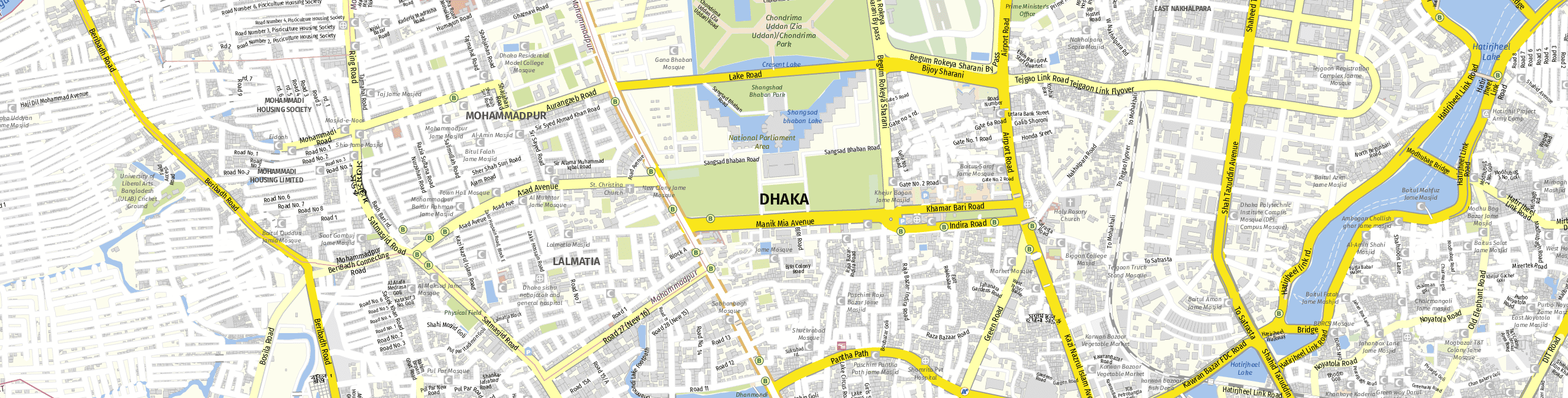
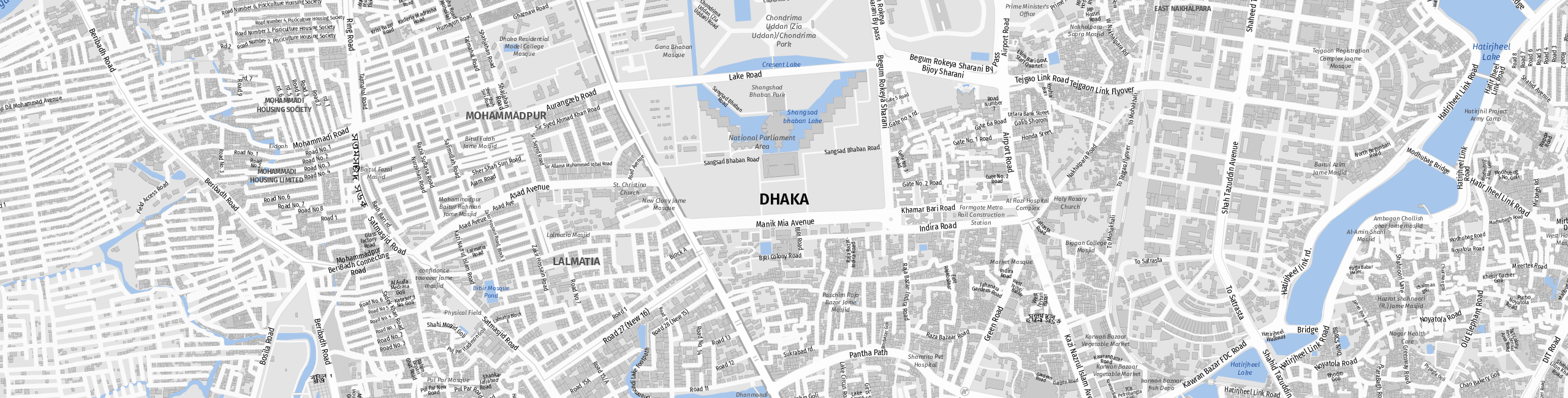
    Our city map of Dhaka (Bangladesh) shows 29,650 km of streets and paths. If you wanted to walk them all, assuming you walked four kilometers an hour, eight hours a day, it would take you 927 days. And, when you need to get home there are 801 bus and tram stops, and subway and railway stations in Dhaka.

    With a total area of 6 square kilometers, public green spaces and parks make up 0.029% of Dhaka’s total area, 20,413 square kilometers. That means each of Dhaka’s 21,741,000 residents has an average of 0.3 square meters.

    When people in Dhaka want to go out, they are spoilt for choice; our map shows more than 115 cafés, restaurants, bars, ice-cream parlors, beer gardens, cinemas, nightclubs and theatres. The city also boasts more than 252 sights and monuments, and far more than 9,979 retailers. Feeling tired? Our map shows more than 395 hotels and guest houses, where you can rest.


    • Map download service

      City, regional and country maps from Kober-Kuemmerly+Frey can be generated with the optimum print or screen resolution for every application. Use our maps in your image brochures and travel catalogues, or on your website. Or add an attractive location map to your real estate flyer. b-ok africa book

    The following companies use maps from mapz.com

    • Marlit-Christine Heinersdorff
      LOOXX* magazine
      Thanks to mapz.com, the service city map in our LOOXX* magazine uses our corporate colors. Brilliant!
    • Dieter C. Rangol
      German Swimming Pool Federation
      mapz.com gives our member companies rapid, easy access to professionally designed location maps for their websites, brochures and catalogues.
    • Daniel Tolksdorf
      Aengevelt Real Estate
      mapz.com offers the best looking maps for our high-quality real estate flyers.
    • Silja Schelp
      Humboldt Travel
      mapz.com helps us create attractive maps showing the special features of our tours, anywhere in the world.

    B-ok Africa Book Apr 2026

    In the end, the chronicle of B-OK Africa is about negotiation — between scarcity and abundance, law and need, markets and commons. It is a story of people making pragmatic choices to keep knowledge moving, even when the systems that produce that knowledge are imperfect. Most of all, it is a quiet testament to the fact that books, whether bound in cloth or rendered in pixels and photocopies, remain social things: vessels of practice, memory, identity, and aspiration, and the sites where communities continue to argue over what it means to share them fairly.

    That encounter forced broader conversations in the city’s cultural circles. Writers who had learned their craft in DIY workshops grappled with the practical realities of sustaining art. Librarians and legal scholars drafted frameworks for fair use tailored to the region’s educational exigencies. An alliance formed — thin, fragile, earnest — aiming to reconcile access with sustainability: community-driven licensing, revenue-sharing models for digitized works, and a local fund to support the production of new texts in underrepresented languages.

    Amina herself negotiated these tensions pragmatically. She kept a ledger — not just of transactions but of requests and refusals. Rare, newly published titles she steered customers toward purchasing from the only licensed outlet in town; older, inaccessible works she scanned for archival interest. When an independent publisher arrived one afternoon with a stack of children’s books printed in a minority language, Amina offered shelf space and a commission. She began, in her quiet, market-savvy way, to broker a fragile middle path: pairing access with conscious support for local creators.

    In the dim glow of a cracked streetlamp, the little shop on Kwame Nkrumah Avenue kept its door open long after neighboring businesses shuttered. For many in the neighborhood it was just “the book stall” — a narrow room stacked floor-to-ceiling with mismatched spines, a place where exam crammers and curious readers rubbed shoulders. But a small paper sign taped near the counter had a different name scrawled on it: B-OK Africa.

    Across town, a retired teacher named Samuel kept visiting the stall. He came for the history pamphlets and stayed for the conversations. He had watched decades pass where libraries were built and neglected, where curricula pivoted without consulting communities, where whole languages receded into oral memory. To him, B-OK Africa was both remedy and reminder: remedy because it stitched together scattered knowledge, reminder because it exposed how precarious cultural transmission had become in the gaps between formal institutions.

    The chronicle of B-OK Africa, however, is not a single, triumphant arc; it is braided with ethical complexity. In a nearby cafe, an earnest debate took shape between two graduate students. One praised the stall for democratizing information, arguing that knowledge hoarded behind paywalls or expensive editions was a modern barrier to participation. The other — visiting from a publishing studies program — worried about the long-term consequences: authors losing royalties, small presses unable to sustain local-language publishing, and the erosion of a market that supports editors, designers, and distribution networks. Between them, the question hung: who benefits when access is widened, and at what cultural or economic cost?